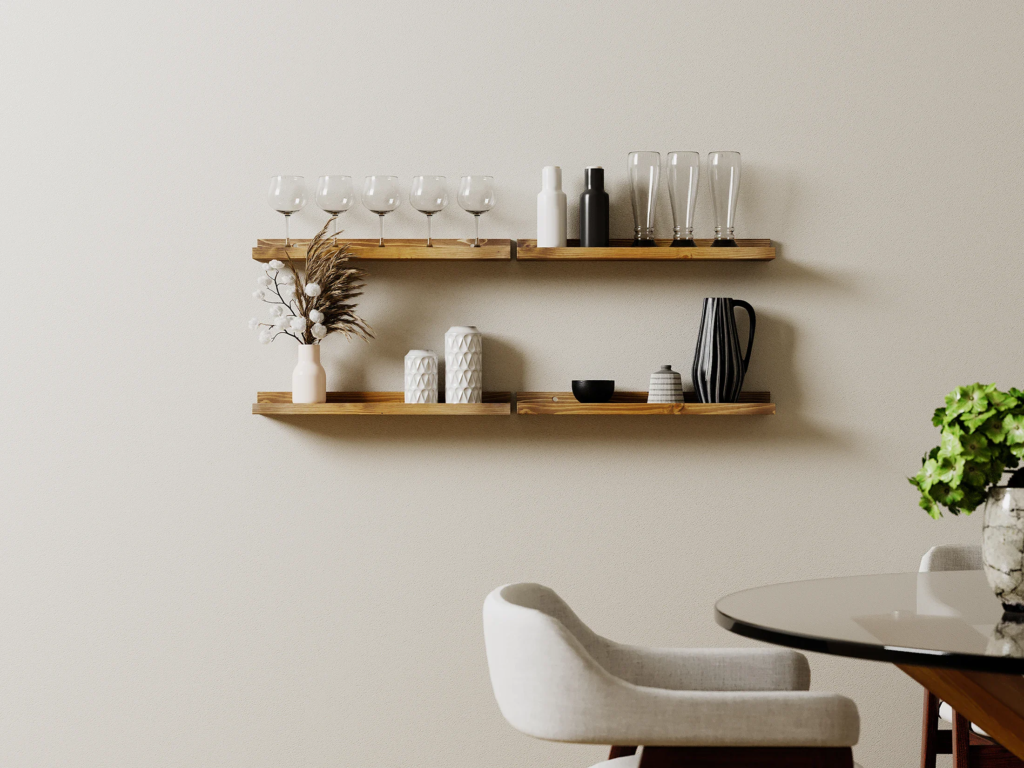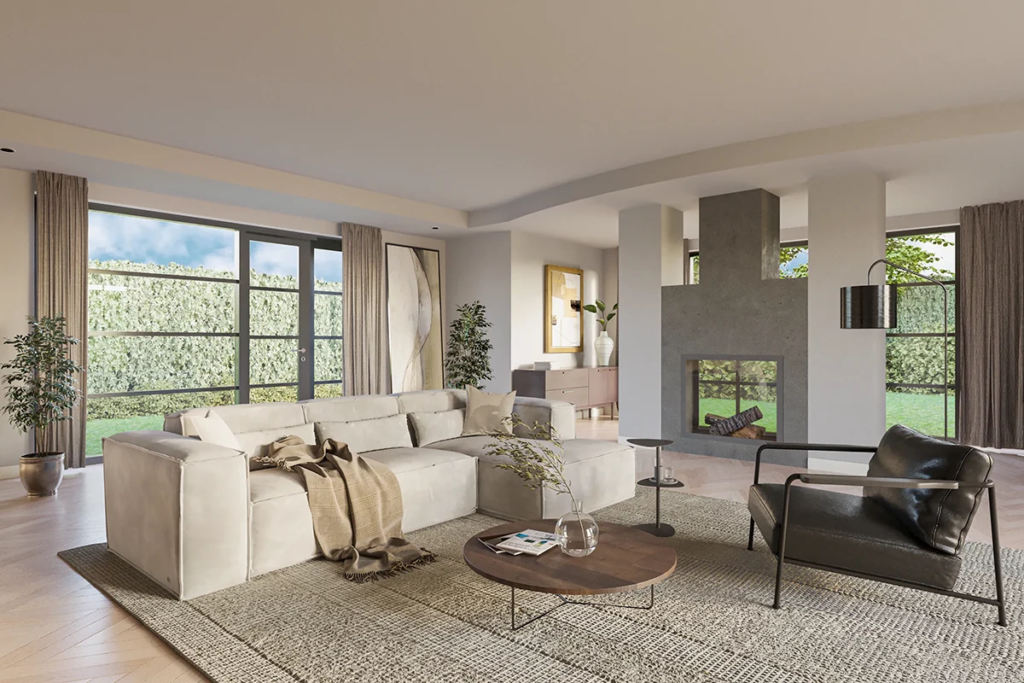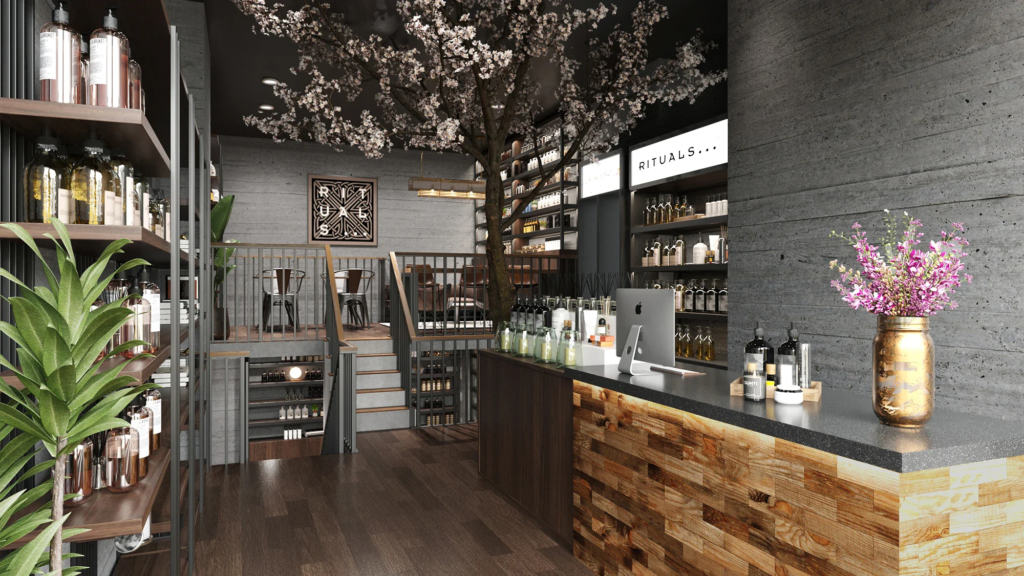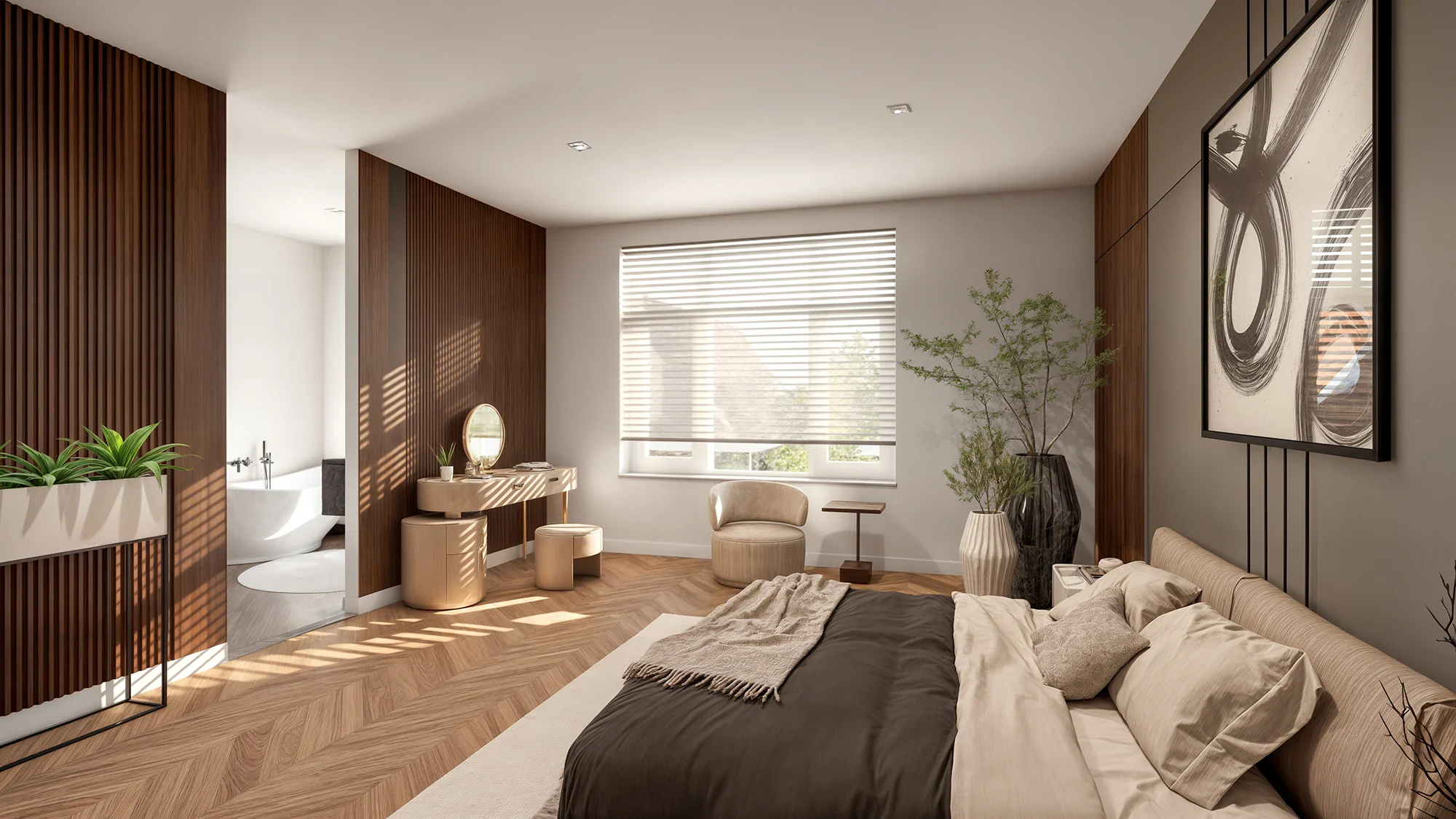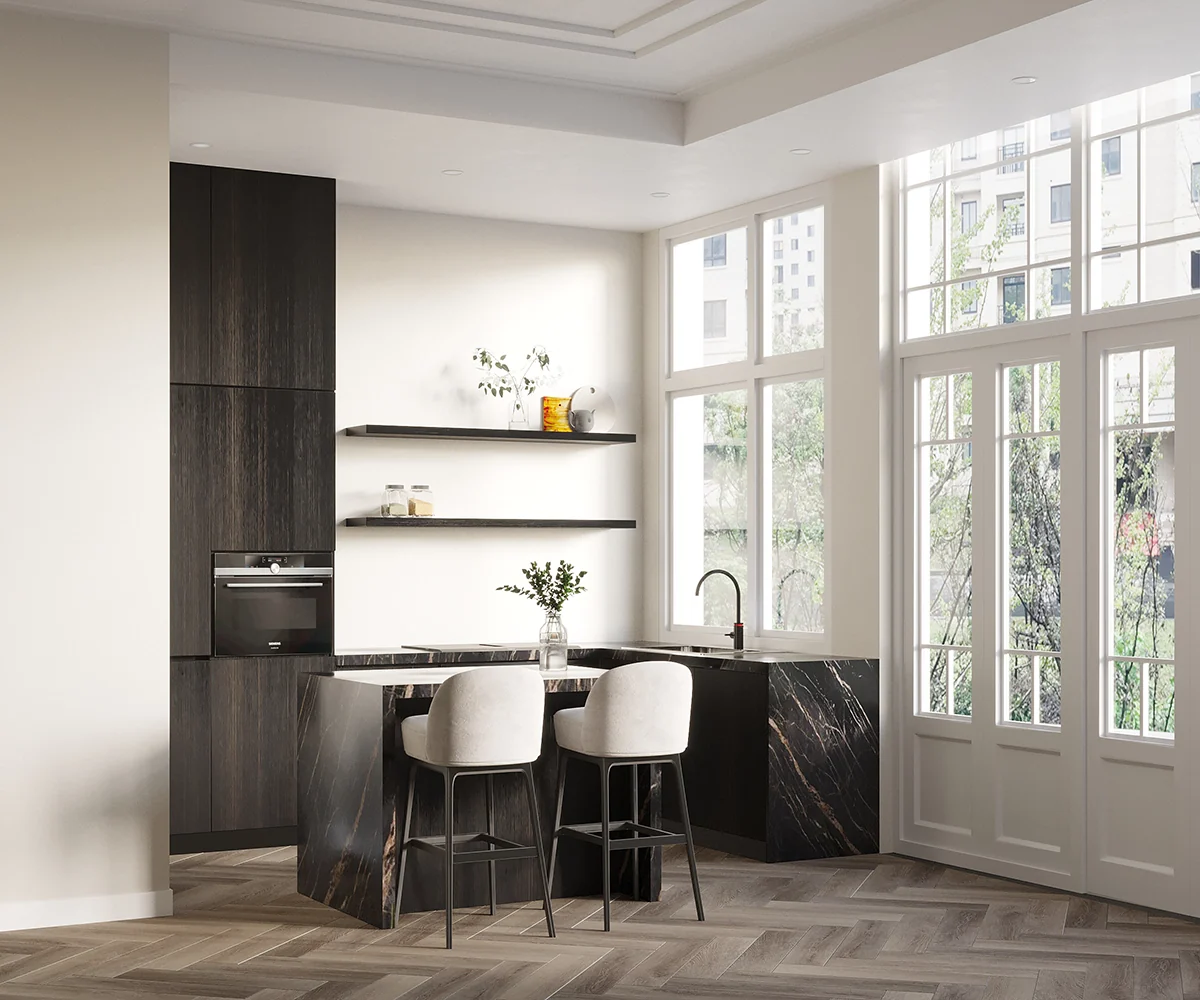
In short An artist impression is a photorealistic 3D visualization that shows how a building or space looks before it is built. There are four types: exterior visualization, interior visualization, aerial visualization and atmospheric floor plan. Prices start at around 400 euros per image for interiors and 500 euros for exteriors, including two revision rounds, with an average turnaround of two weeks. Below you will read about the meaning, types, costs and the production process, based on more than 500 projects we have delivered since 2018 for clients including Philips, Gemeente Amsterdam and ERA Contour.
Of the 69,200 new-build homes completed in the Netherlands in 2025 (CBS, 2026), the vast majority are sold before the first stone is laid. In that process, an artist impression is not a side issue but your most important commercial tool: according to Funda data, listings with a complete visual presentation package are viewed up to 2x longer and receive up to 2x as many contact requests. Yet many clients do not know when to use one, what a fair price is, or which type they actually need.
What is an artist impression?
An artist impression is a digital, photorealistic representation of a building, interior or outdoor space that shows how it will look once realized. It is created with 3D software such as 3ds Max in combination with render engines like V-Ray or Corona, and the end result is often barely distinguishable from a real photograph.
The term “artist impression” is used in the Netherlands mainly in the real estate sector, but the technology behind it is broader: architecture firms, product designers and urban planners all use the same technique. Important detail: it is emphatically not a technical construction drawing. It is a communication tool, not a contractual document.
Difference between render, photo impression and 3D visualization
In practice these terms get mixed up. Here you can see the differences at a glance:
Legally, an artist impression is not a guarantee. In a ruling on the Red Apple tower in Rotterdam (21 December 2016) the court determined that buyers can derive only limited rights from images in a sales brochure, as long as a clear reservation is included (Team Advocaten, 2016). Lawyers at LXA Advocaten recommend explicitly stating with every artist impression that it is an indication. An important point for developers: always include a disclaimer in your brochure and sales materials.
An artist impression is a photorealistic 3D visualization that shows a design before it is realized. According to Dutch case law (Red Apple Rotterdam, 2016), buyers can only derive rights from such an impression if no clear reservation has been included. That is why every professional artist impression contains a disclaimer about material choice and detailing.
Read more: 3D visualizations for a renovation.
When do you need an artist impression?
The Dutch housing market sells fast: the average selling time in Q1 2026 was 32 days (NVM, 2026). In those 32 days buyers have to be convinced, and visual presentation is decisive there, especially for new builds where there is no property yet to show. But not every project calls for an artist impression. The six scenarios below are the moments where investing in 3D visualization demonstrably pays off.
The 6 most important use cases
- New build , You are selling something that does not exist yet. Buyers need to be able to feel how it will turn out. Of the 69,200 homes realized in the NL in 2025 (CBS, 2026), the vast majority were sold before completion with the help of visual presentation.
- Renovation or refurbishment , Show the end result before the first wall comes down, so clients can say yes with confidence.
- Sales campaigns , Brochure, website, Funda listing, social media. Funda data shows that a complete visual package (photo, video, 360°, floor plan) generates up to 2x more contact requests than listings without.
- Environmental permit , Since the introduction of the Environment Act on 1 January 2024, the regular procedure is 8 weeks, the extended procedure 26 weeks (IPLO, 2024). Aesthetics committees assess plans faster and more positively with photorealistic context, which often saves a reassessment round and keeps you within the deadline.
- Crowdfunding and institutional funding , Investors want a tangible image. A strong visual makes pitch decks immediately more powerful.
- Styling choices and material decisions, Show three variants, discuss taste, decide faster.
Which visualization do you choose when?
According to Funda, listings with a complete visual presentation package receive up to 2x more contact requests. Six scenarios in which an artist impression achieves its return on investment: new-build sales, renovation, marketing campaigns, permit procedures (8 or 26 weeks under the Environment Act), crowdfunding and material choices. For vacant properties without renovation, virtual staging is cheaper and faster; for area development, an aerial visualization is more suitable than an interior impression.
Compare: virtual staging vs artist impression.
4 types of artist impressions (with examples)
Artist impressions are not one single thing. There are four main types, each serving a different purpose and used at different stages of a project. Which type you need depends on what you want to show: the exterior, the interior, the context in the landscape, or the layout itself.
1. Exterior visualization
This is often the first visual a project needs. You show the facade, the roof, the entrance, the immediate surroundings and the light at a specific time of day. Used well, a single golden-hour shot convinces more than ten construction drawings.
When to use: environmental permits, new-build brochures, Funda sales, area marketing.
Price indication: from €499 per image (architectural visualization).
2. Interior visualization
Shows atmosphere, light, materials and layout. This is the type that works most strongly on emotion, buyers need to be able to see themselves on that sofa, behind that kitchen island, in that light.
When to use: home sales, styling presentations, hospitality and retail design, interior architecture pitches.
Price indication: from €399 per image (interior visualization).
3. Aerial visualization
Bird’s-eye or drone perspective. Show the context: how a new-build block fits into the street, the neighborhood, the city. Strong for urban planning schemes and larger area developments.
When to use: area development, master plans, institutional pitches (as we did for clients in the Gemeente Amsterdam project), brochures for larger complexes.
4. Atmospheric floor plan
A 2D floor plan upgraded to a photorealistic top-down view with furniture, floors and lighting. The best of a floor plan (overview) plus the best of a render (atmosphere). According to Funda data, quality floor plans already lead to an average of 20% more responses to a listing.
When to use: estate agent presentations, brochures, Funda Plus listings, interior architecture reports (atmospheric floor plans).
From our 500+ projects: for home sales through estate agents, a combination of one strong exterior shot plus one interior impression demonstrably performs better than three exterior shots. Buyers want to be drawn in outside and convinced inside. This ratio (1:1) proves time and again to be more effective than focusing on the exterior alone.
The four main types of artist impressions are exterior visualization (facade, surroundings), interior visualization (atmosphere, layout), aerial visualization (contextual overview) and atmospheric floor plan (photorealistic top-down floor plan). Prices start at €399 per visual; the type always depends on the goal: marketing, permit, or design decision.
View examples in our portfolio.
What does an artist impression cost in 2026?
A professional artist impression costs between €390 and €1,500 per visual in the Netherlands in 2026, depending on type, level of detail and number of images. Comparable Dutch studios use varying starting prices: 3DL starts from €390 for an exterior still, and Mars3D works with €600 to €1,200 for exteriors and €450 to €950 for interiors. At Studio Renders our packages start at €399 for an interior visualization and €499 for an exterior, including two revision rounds. This transparency is deliberate: many firms do not publish prices, which forces clients into requesting quotes without any frame of reference.
What determines the price?
Five factors influence what an artist impression ultimately costs:
- Complexity of the design , a minimalist studio is quicker than a multifunctional building with many facade profiles.
- Level of detail and resolution , a 4K print for a brochure requires more work than a 1920px web resolution.
- Number of images from the same 3D model , the first image is the most expensive (building the 3D model); additional viewpoints are considerably cheaper.
- Material supplied , complete DWG files, material samples and moodboards take hours out of the process.
- Turnaround time , rush jobs within a week carry a surcharge.
Price comparison Studio Renders versus the Dutch market
An artist impression costs between €390 and €1,500 per visual in the Netherlands in 2026. Starting prices at Studio Renders: €399 (interior), €499 (exterior), €165 (virtual staging or extra image). For comparison: 3DL starts at €390 (exterior), Mars3D works with €600 to €1,200 for exteriors and €450 to €950 for interiors. Price is determined by complexity, level of detail, number of images, material supplied and turnaround time.
Receive a free price indication for your project within 24 hours.
The process from briefing to end result
A typical artist impression project takes about 2 weeks at Studio Renders, including two revision rounds. That process is built from four deliberately separated phases, so you avoid expensive revisions at the end and know, as a client, at which moment you have to make which decisions. Below you can see the steps as we go through them on every project.
What do you supply?
The quality of your output begins with what you supply as a client. The more complete the package, the shorter the intake time:
- Minimum: floor plan (DWG or PDF), facades, a brief description of the goal.
- Ideal: floor plan + facades + sections in DWG, material samples or RAL codes, moodboards (Pinterest boards work fine), reference photos of the desired atmosphere, preferred time of day/light.
- For interiors: floor finish, furniture references, color scheme.
Why two revision rounds?
One round is too few, three too many. Round 1 usually holds the composition feedback (camera viewpoint, framing). Round 2 holds the fine-tuning (materials, light, small corrections). We kept this structure after 500+ assignments because it consistently leads to the best end result without projects dragging on.
5 benefits proven with figures
In 2026, an artist impression is a conversion tool with measured return on investment. Dutch platform data from Funda, sector reports from ABN AMRO and CBS, plus international research from McKinsey and Dodge Data & Analytics substantiate five concrete benefits. Where possible the figures come from Dutch sources, so they translate directly to Dutch real estate and construction practice.
The 5 benefits with hard figures
1. Up to 2x more contact requests on Funda. Homes with a complete visual presentation package (photo, video, 360°, floor plan) receive up to 2x as many contact requests and are viewed 2x as long as listings without (Funda data via Mooijekind Vleut, 2024). A professional floor plan alone already generates an average of +20% more responses.
2. Average selling time 32 days in the NL. In Q1 2026 a home in the Netherlands sold on average in 32 days (NVM, 2026). Stronger visual presentation keeps that pace intact and for new builds where there is no tangible product, 3D visualization is often the only way to get a viewing rhythm going at all.
3. 33% of NL construction companies use BIM; architects European frontrunners. According to ABN AMRO (2024), 33% of Dutch construction companies use BIM. The European Architectural Barometer shows that Dutch architects are European frontrunners with more than 50% BIM adoption, far above Germany (5%) and Poland (4%). 3D visualization is the natural commercial extension of that infrastructure.
4. More than 5% of revenue lost to failure costs in NL construction. Dutch construction companies lose an average of more than 5% of their revenue to failure costs, together amounting to more than €5 billion per year (ABN AMRO, 2019). Historical research by USP Marketing Consultancy even pointed to peaks of up to 11.4%. Errors that are already visible in a 3D model, clashes between structure and installations, wrong window positions, conflicts with the surroundings, no longer reach the building site.
5. Up to 40% fewer design changes with BIM/3D (international benchmark). According to the Dodge SmartMarket Report (2021), projects using 3D/BIM receive up to 40% fewer change orders during the construction phase. Given the 33% NL adoption (ABN AMRO), the room for gains in the Dutch market is still considerable.
Proven in practice
These figures match what we see ourselves with clients such as Corum Investments, Philips, Gemeente Amsterdam and ERA Contour. Good visuals remove decision uncertainty, for investors, buyers, and internal stakeholders alike.
Dutch and international data substantiate five benefits of artist impressions: up to 2x more contact requests and 2x longer viewed listings on Funda (2024), +20% responses with a quality floor plan, 33% BIM adoption in NL construction (ABN AMRO, 2024) and up to 40% fewer design changes on 3D/BIM projects (Dodge, 2021). Dutch construction companies lose more than 5% of their revenue to failure costs, €5 billion per year according to ABN AMRO (2019).
View delivered projects in our portfolio.
Have an artist impression made at Studio Renders
Studio Renders has been creating artist impressions since 2018 for property developers, architects, estate agents and public clients. In that period we have delivered 500+ projects, with offices in Rotterdam, The Hague and Amsterdam. Clients such as Corum Investments, Philips, Gemeente Amsterdam and ERA Contour work with us because we combine three things that otherwise often come separately: photorealistic quality, transparent fixed prices and a structured process with two revision rounds included.
Why clients choose us
- 13+ years of experience with our founder as a 3D visualizer, the entire stack from 3ds Max to V-Ray and Corona Renderer.
- Transparent prices upfront from €399 per interior visual and €499 per exterior, no hidden costs.
- Two revision rounds as standard included in every assignment. No additional billing for normal feedback.
- A first price indication within 24 hours after your quote request.
- Three office locations in the Randstad for intake meetings: Rotterdam, The Hague, Amsterdam.
By Ilias Azdoufali , 3D visualizer & founder of Studio Renders. 13+ years of experience in architectural visualization. Contributed to 500+ projects in the Netherlands and Belgium for property developers, architecture firms and public clients.
GET INSTANT ANSWERS TO FAQS ABOUT ARTIST IMPRESSIONS